 marinepoint


Deck hardware and stainless steel: spotting and stopping corrosion
2026-09-14 · Marine Point
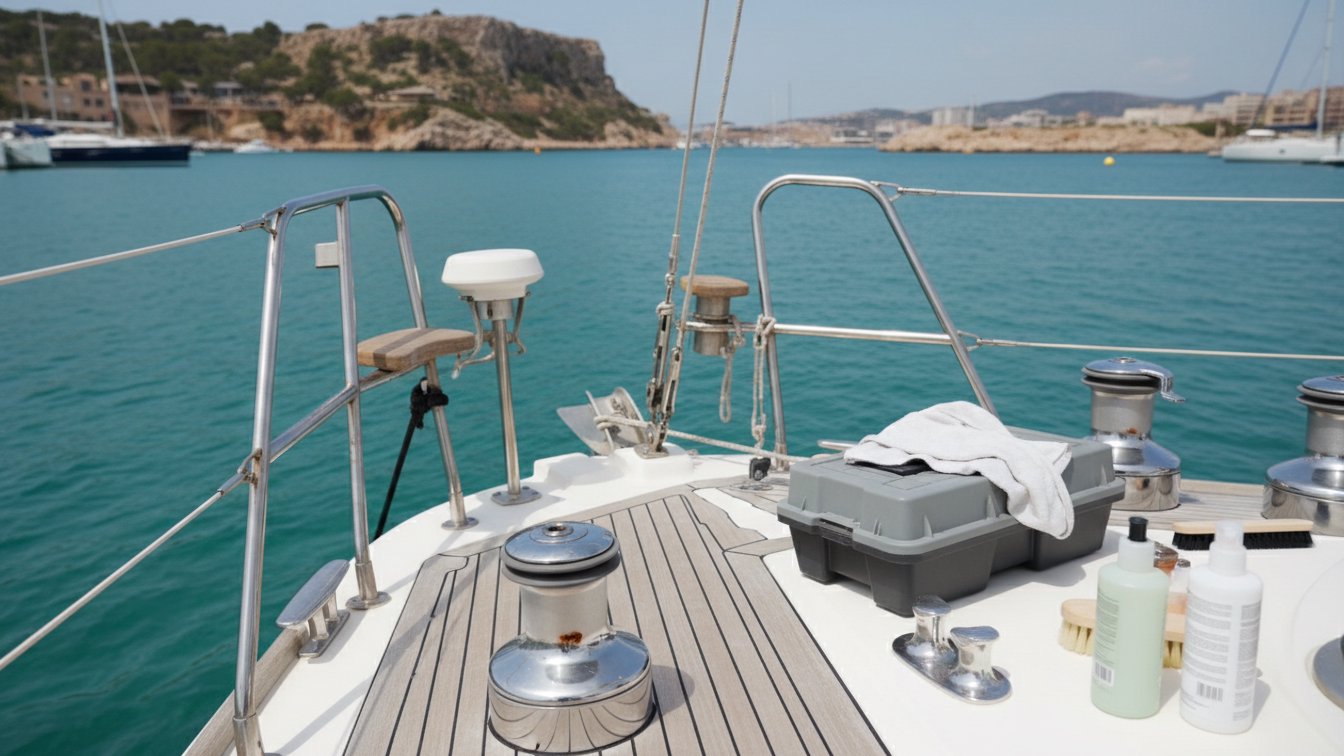
Stainless steel is not immune to corrosion, especially in the Balearic Islands. The combination of salt, persistent humidity, warm waters and an intensive sailing season can leave stains, small rust spots or weakened areas on deck hardware. Acting in time prevents an aesthetic issue from becoming a fault or, worse still, a risk at a load-bearing point. Our recommendation is simple: inspect, identify the cause and replace any item whose strength is already in doubt.
Telling surface corrosion from a real problem
Brown stains on stainless steel do not always come from the fitting itself. They are often iron particles deposited by tools, dust from nearby work or contact with other metals. If they disappear after proper cleaning and the surface is uniform, it may be surface contamination.
Pitting corrosion deserves closer attention. It can be recognised by small spots, craters or cavities, usually in corners where salt and water accumulate: beneath washers, in joints, around screws or in poorly ventilated areas. Although it may begin in a localised area, it reduces the useful thickness of the part. We will inspect stanchions, cleat bases, hinges, latches and any hardware subject to tension or repeated loads especially carefully.
Galvanic corrosion: when two metals do not get along
Galvanic corrosion occurs when different metals are in electrical contact and there is a conductive medium, such as salt water or marine humidity. One of the metals may deteriorate at an accelerated rate in order to protect the other. It is common to find it in fixings, joints between stainless steel and aluminium, or accessories installed on different metal parts.
Signs may include whitish powder, discolouration, swelling in the contact area or concentrated deterioration next to a fixing. It is not enough simply to polish the surface: it is necessary to identify the materials involved, check whether moisture is being retained and assess the insulation between parts. To renew deck components, you can browse our selection of deck hardware and accessories.
Cleaning, passivation and prevention
Rinsing with fresh water after sailing and drying points where water is retained are simple measures that help greatly. We should avoid products or tools that scratch stainless steel or leave iron residues, as they damage its protective surface layer.
Passivation aims to restore that protective layer when the material has been worked, contaminated or thoroughly cleaned. It is not a solution for a part that is already pitted or structurally compromised, and it must be carried out with suitable products and procedures. For critical hardware or advanced corrosion, we recommend having it assessed by a professional before applying treatments.
It is also advisable to avoid direct contact between incompatible metals, improve drainage at bases and not seal in a way that creates a permanent pocket of moisture. Regular cleaning is preferable to aggressive intervention at the end of the season.
When to replace a fitting
We will replace without delay parts with cracks, deformation, abnormal play, damaged threads or deep pitting, especially if they are used for mooring, anchoring, steering or access on board. Nor do we recommend reusing fasteners that show visible corrosion when removing an accessory: their external appearance does not guarantee that they retain their load-bearing capacity.
If you are not sure whether a fitting can continue to work safely, it is best not to take risks. We can advise you on replacements and compatibility, and for cases requiring inspection or specialist fitting we will advise you to use a professional. Contact us to review your case and find a sensible solution for your boat.